Prefetch-Aware Cache Replacement
预取数据通常构成 cache 的很大一部分,所以与预取器的交互是设计 cache 替换策略时需要考虑的重要因素
设计预取感知 cache 替换策略有两个主要目标:
- 替换策略应避免 cache pollution,这种污染是由不准确的预取引起的
- 替换策略应优先淘汰那些可以被预取的 cacheline ,而不是那些难以预取的 cacheline
Belady 的 MIN 算法在无预取的情况下被证明是最优的,但在存在预取器的情况下是不完备的,因为它忽略了第二个设计目标:降低可预取 cacheline 的优先级
降低 Cache Pollution
此类解决方案可分为两大类:
- 第一类从预取器获取反馈,以识别可能不准确的预取请求
- 此类策略通常需要与预取器进行明确的协同设计,或对现有预取器进行修改
- 例 1,Ishii 等人利用 AMPM 预取器的内部状态来告知预取 cacheline 的插入优先级
- 例 2,KPC 通过协同设计预取器来提供关于置信度和预计重用时间的反馈。这些信息随后被用于决定是将预取插入 L2 Cache 还是 L3 Cache,同时也用于确定插入 cacheline 的 RRPV 插入位置
- Yasuo Ishii, Mary Inaba, and Kei Hiraki. Unified memory optimizing architecture: memory subsystem control with a unified predictor. In Proceedings of the 26th ACM International Conference on Supercomputing, pages 267–278, 2012.
- KPC:
Jinchun Kim, Elvira Teran, Paul V Gratz, Daniel A Jiménez, Seth H Pugsley, and Chris Wilkerson. Kill the program counter: Reconstructing program behavior in the processor cache hierarchy. In Proceedings of the Twenty-Second Int’Conference on Architectural Support for Programming Languages and Operating Systems (ASPLOS), pages 737–749, 2017.
- 第二类策略独立于预取器工作,通过监控 cache 行为来调整替换决策
- 此类策略可与任何预取器配合使用,但可能缺乏精确的预取器特定信息
- 例如,FDP 和 ICP 引入了动态估计预取准确性的方法,并将不准确的预取项插入到低优先级位置
- FDP 通过统计一个时间周期内有用预取与总预取的比例,以粗粒度估计准确性
- ICP 对 FDP 进行了增强,考虑了近期被踢出的预取 cacheline ——如果这些 cacheline 能在 cache 中多保留一段时间,本应被视为准确的
- PACMan 则针对每个时间周期,为预取请求确定最佳的插入与提升策略
- FDP:
Santhosh Srinath, Onur Mutlu, Hyesoon Kim, and Yale N Patt. Feedback directed prefetching: Improving the performance and bandwidth-efficiency of hardware prefetchers. In Proceedings of the 13th International Symposium on High Performance Computer Architecture (HPCA), pages 63–74, 2007.- ICP:
Vivek Seshadri, Samihan Yedkar, Hongyi Xin, Onur Mutlu, Phillip B Gibbons, Michael A Kozuch, and Todd C Mowry. Mitigating prefetcher-caused pollution using informed caching policies for prefetched blocks. ACM Transactions on Architecture and Code Optimization (TACO), 11(4):51, 2015.- PACMan:
Carole-Jean Wu, Aamer Jaleel, Margaret Martonosi, Simon C. Steely, Jr., and Joel Emer. PACMan: prefetch-aware cache management for high performance caching. In 44th Annual IEEE/ACM International Symposium on Microarchitecture (MICRO), pages 442–453, 2011b.
PACMan 定义了 RRIP 的三种变体:
- PACMan‑M: 侧重于通过将预取项插入到 LRU 位置来避免 cache pollution
- PACMan‑H: 通过不在 cache hit 时提升预取请求,来降低可预取 cacheline 的优先级
- PACMan‑HM
并使用 set dueling 来寻找给定周期内的最佳插入策略
| Baseline DRRIP | PACMan-M on DRRIP | PACMan-H on DRRIP | PACMan-HM on DRRIP | |||||
|---|---|---|---|---|---|---|---|---|
| Policy | Metric | All | Demand | Prefetch | Demand | Prefetch | Demand | Prefetch |
| SRRIP | Insertion | 2 | 2 | 3 | 2 | 2 | 2 | 3 |
| Re-Reference | 0 | 0 | 0 | 0 | No Update | 0 | No Update | |
| BRRIP | Insertion | Mostly 3 | Mostly 3 | Mostly 3 | Mostly 3 | Mostly 3 | Mostly 3 | Mostly 3 |
| Re-Reference | 0 | 0 | 0 | 0 | No Update | 0 | No Update | |
降低可预取 Cacheline 的优先级
在存在预取的情况下,Belady 的 MIN 算法是不完备的,因为它没有区分可预取 cacheline 和难预取 cacheline
MIN 算法会同等倾向于缓存 prefetch request cacheline(可预取 cacheline ) ,以及 demand request cacheline(难预取 cacheline),MIN 算法最小化了 cache misses 的总数(包括 prefetch cacheline),但它并未最小化 demand cacheline misses 的数量
Demand-MIN (2018)
Akanksha Jain and Calvin Lin. Rethinking belady’s algorithm to accommodate prefetching. In 2018 ACM/IEEE 45th Annual International Symposium on Computer Architecture (ISCA), pages 110–123. IEEE, 2018.
Demand‑MIN 能在存在预取的情况下最小化 demand misses
- Belady MIN 踢出未来最远被重用的 cacheline
- Demand‑MIN 踢出未来将被预取的最远的 cacheline,如果不存在这样的 cacheline ,则踢出未来将收到 demand 请求的最远的 cacheline,从而为那些无法被预取的 cacheline 提供了空间
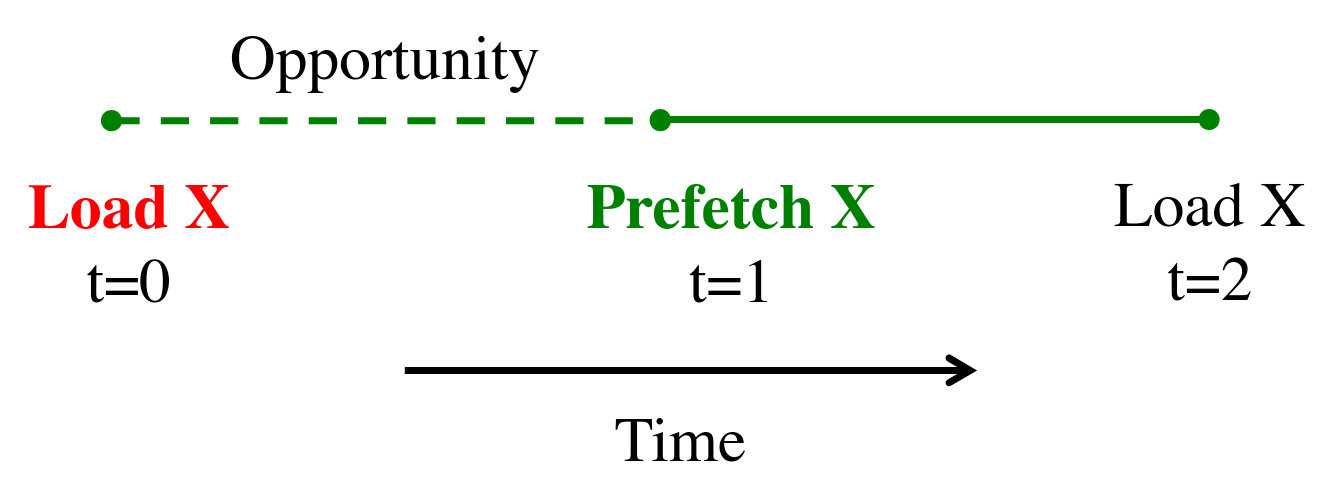
代价:Demand‑MIN 带来的 demand hit rate 提升,是以增加大量 prefetch miss 为代价的,导致了额外的预取流量
MIN 和 Demand-MIN 定义了一个设计空间的两个极端点:MIN 在一个极端上最小化总流量,而 Demand‑MIN 则在另一个极端上最小化 demand miss
Flex MIN (2018)
Flex-MIN 选择了一个介于 MIN 和 Demand-MIN 之间的点,使得所选点在 demand hit rate 和 memory traffic 之间取得良好的权衡
Protected line: 会被 Demand-MIN 踢出但不会被 Flex-MIN 踢出的 cacheline,因为它会产生 memory traffic 却无法显著提升 hit rate
Flex‑MIN 策略定义为:踢出那个在未来最远时刻会被预取且非 protected line 。如果不存在这样的 cacheline ,则默认使用 MIN
Flex-MIN 通过使用一种简单的启发式方法来识别 protected line
与 MIN 和 Demand‑MIN 不同,Flex‑MIN 在任何理论意义上都不是最优的,因为它基于启发式方法构建
Harmony
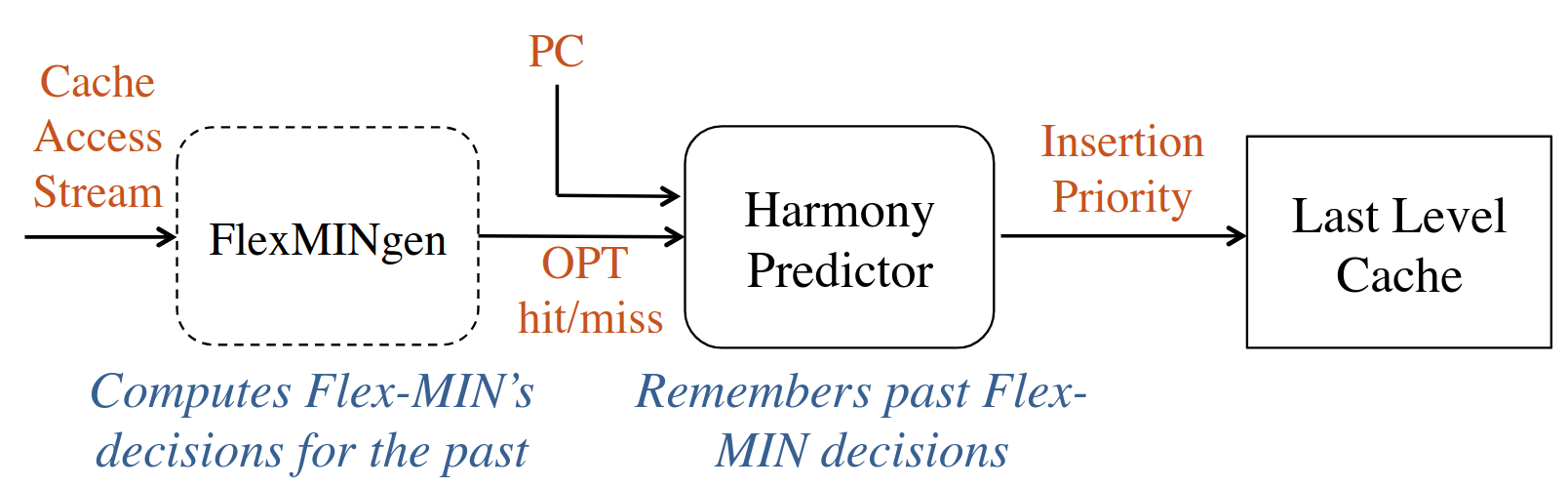
Harmony 向 Flex-MIN 学习,探索了 MIN 和 Demand‑MIN 之间丰富的设计空间
Harmony 的整体结构与 Hawkeye 类似,主要区别在于 Harmony 用 FlexMINgen 替换了OPTgen,其中 FlexMINgen 模拟了 Flex‑MIN的解决方案
与 Hawkeye 类似,Harmony 的预测器也是基于 PC 的,只是 Harmony 有两个预测器,一个用于 demand request ,另一个用于 prefetch request